Article
The Future of Procurement Is Now: Build the Team You’ll Need Tomorrow
Traditional procurement roles are no longer enough for an environment shaped by permanent disruption, AI and rising sustainability requirements. This article describes five core roles for a procurement team focused consistently on business outcomes: from value partnering and supplier ecosystems to data-driven decisions, automation and integrated compliance. It explains how operational tasks can be organized in the future, how cross-functional squads take shape and which practical steps companies can take over the next 90 days.
- Procurement organization
- Capabilities & roles
- Transformation
Your future procurement team has no buyers, no category managers, no data analysts. Still sounds like science fiction? It’s much closer than you think. 👀
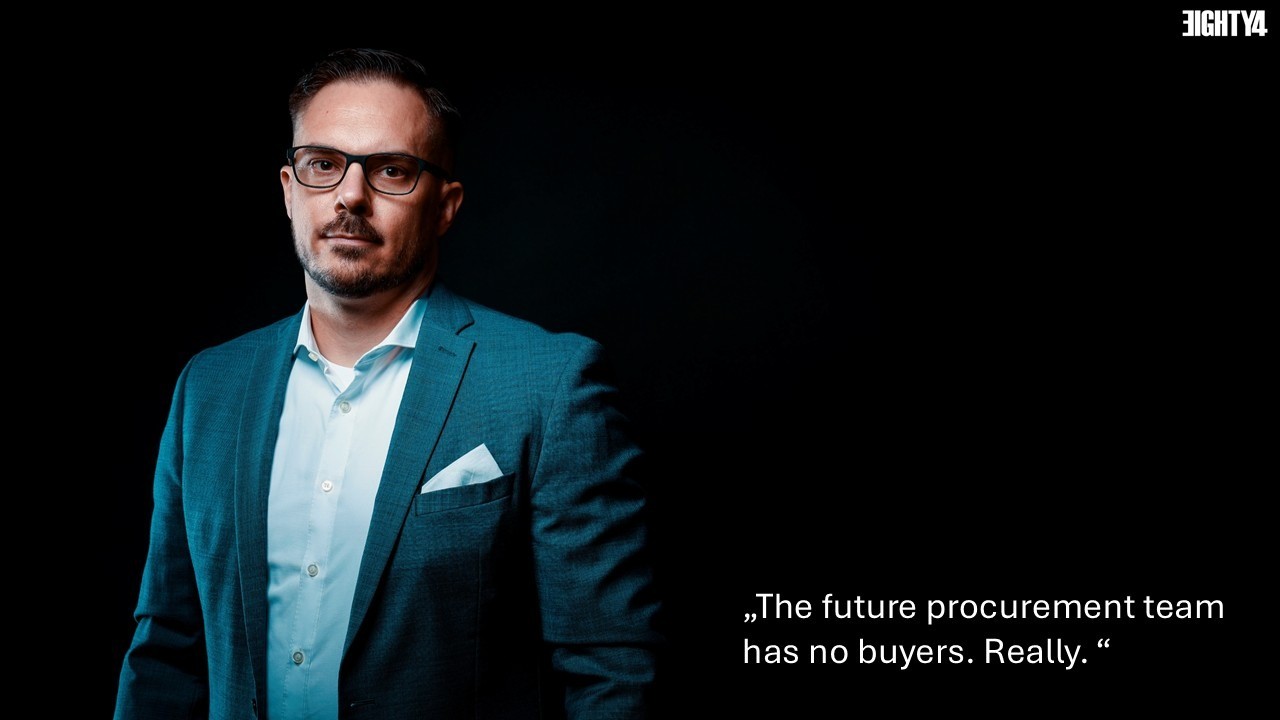
The future procurement team has no buyers. Really.
The future procurement team does not have strategic or operational buyers. It does not have category or commodity managers. It will not have data analysts or scientists.
There will be no project buyers. No lead buyer. You won’t find supplier relationship or development managers. No strategic or operational team leads. No supplier quality engineers.
You also won’t see contract or risk managers. A procurement excellence manager is not needed. Data managers or stewards are a relic from the past. Sustainability or ESG managers will not sit in a separate box.
The procurement team of the future will not have any of these roles. At least, not the way you know them today.
Do you find yourself in there? Do you disagree? Good. Let’s find out why this matters and what you should build instead.
1. The world changed – but most procurement org charts didn’t
There is not a single company that was not impacted by COVID, the war in Ukraine, the Ever Given stuck in the Suez Canal, and many other conflicts and geopolitical tensions around the globe.
You know the list of challenges, but let’s make it explicit. This is the environment your “future team” has to master 👇
📦 1. Supply Chain Disruptions & Resilience
- Geopolitical instability: trade wars, sanctions, regional conflicts disrupting routes and markets.
- Natural disasters & climate risks: floods, droughts, wildfires damaging infrastructure and production.
- Pandemic aftershocks: COVID exposed fragile dependencies and some industries still struggle.
- Single-source dependencies: overreliance on specific suppliers or regions (semiconductors, chemicals, logistics hubs).
⚙️ 2. Rising Complexity
- Globalized, fragmented networks: multi-tier supplier setups with limited transparency.
- Increasing product customization: more variants, more complexity in planning and sourcing. Companies "try" to standardize, but fail. Or they simply cannot handle variants.
- Shorter product life cycles: innovation speed demands faster, more agile supply chains.
💻 3. Digitalization & Data Challenges
- Data silos & poor integration: legacy systems block end-to-end visibility.
- Cybersecurity threats: more digital touchpoints, more vulnerabilities.
- Slow tech adoption: AI, automation, predictive analytics exist, but are not broadly used. Not even planned.
🧑🤝🧑 4. Talent & Workforce
- Skill shortages: not enough qualified procurement talent in the market. In addition, not qualified enough for the future team.
- Aging workforce: demographics make the shortage worse.
- New skill profiles: digital, analytical, ecosystem-oriented people are needed, but your job descriptions still say “buyer”.
🌍 5. Sustainability & Compliance
- New regulations: LkSG, CSRD, CSDDD and local equivalents tightening the screws.
- Carbon footprint pressure: decarbonizing materials, logistics, packaging.
- Circularity: from linear to reuse, repair, recycle. With very real supply implications.
💰 6. Cost Pressures
- Volatile input prices: energy, raw materials, freight.
- Margin squeeze: customers want low prices, owners want high margins.
- Cost vs resilience trade-off: nearshoring, dual sourcing, inventory buffers. They all have a price tag.
🔍 7. Visibility & Risk Management
- Lack of real-time monitoring: many supply chains still run reactively.
- Multi-tier risk: limited insight beyond tier 1.
- Regulatory risk: “not knowing your supplier” now comes with legal and reputational consequences.
So here is the simple question:
👉 If this is your reality, why would you still organize Procurement like it’s 2005?
Strategic vs operational buyer, category manager, project buyer, SRM manager, one data person on the side… this model was never designed for ecosystem orchestration, AI-enabled decisions, and permanent disruption.
2. From “buying stuff” to orchestrating value
Let’s be honest: in many companies Procurement is still seen as “the department that runs RfQs and pushes suppliers on price”. Even organizations with higher maturity are considering Procurement to "manage spend", not to create bsuiness value.
But the job has already changed. The organizational design just hasn’t caught up.
The future procurement team is not built around categories and transactions. It is built around outcomes:
- Resilient supply
- Risk-controlled growth
- Lower total cost
- Measurable sustainability impact
- Better working capital
- Faster innovation with partners
That’s a different game. And it needs different roles.
Instead of functional silos (“you buy”, “you manage contracts”, “you do data”), you need cross-functional, outcome-focused teams that:
- Understand the business model and P&L, not just the price list.
- Orchestrate internal stakeholders and external ecosystems.
- Use data and technology as a default, not as a “nice extra”.
- Integrate sustainability, risk and compliance into every decision and not as an add-on.
Job titles might still say “manager” or “lead”, but the work underneath changes fundamentally.
3. Five core roles your future procurement team really needs
Forget the old titles for a moment. Treat your organization like a product: What “jobs” must Procurement do exceptionally well to win in the next 3–5 years?
Here is a practical model I recommend: five core roles that matter more than your current org chart.
3.1 The Business & Value Partner
This is what many people try to be when they say “strategic buyer” – but with teeth.
- Acts as primary partner to business units, R&D, Operations, Finance.
- Translates business strategy into a sourcing and supplier strategy.
- Owns value creation: cost, risk, innovation, sustainability.
- Builds internal coalitions to actually implement decisions.
Call them “Commercial Lead”, “Procurement Business Partner”, “Value Partner”. The key is: They are measured on business outcomes, not just “savings vs last year”.
3.2 The Ecosystem & Supplier Orchestrator
Suppliers are not just vendors. They’re part of your value creation engine.
This role:
- Designs and manages the supplier ecosystem (strategic, developmental, transactional).
- Builds partnerships where you share risk, data and innovation – not just contracts.
- Works across tiers to understand and mitigate structural risks.
- Connects supplier capabilities with internal needs proactively.
In the old world this was “SRM manager” or “supplier development”. In the future team, it is a core role, not a side job next to running tenders.
3.3 The Data, AI & Decision Intelligence Lead
Your future team is data-native by design.
- Owns the data model for Procurement and Supply – together with IT / Data Office.
- Ensures data quality, integration and access (no more silos).
- Implements and trains AI & analytics use cases (predictive risk, demand, pricing, working capital).
- Combines internal and external (market) data to really establish intelligence in data
- Turns dashboards into decisions, not just “nice views”.
This is not “one analyst in the corner”. It’s a leadership role that shapes how Procurement works every day.
3.4 The Process & Automation Owner
You will not win the future with manual Excel gymnastics and email approvals.
This role:
- Owns end-to-end processes (Source-to-Contract, Procure-to-Pay, Supplier Lifecycle, Risk).
- Designs and governs workflows, automation, and user experience.
- Works closely with IT, Finance and Shared Services.
- Continuously removes friction and low-value work from the team.
In many companies this sits in “Procurement Excellence” today. In the future team, process & automation is not a project – it’s a permanent product.
3.5 The Risk, Sustainability & Compliance Integrator
Regulation and ESG will not go away. They will intensify.
Instead of a separate “sustainability manager” or “risk manager”, you need someone who:
- Translates regulations (LkSG, CSRD, CSDDD, local laws) into practical procurement rules.
- Integrates ESG, human rights and climate criteria into supplier and sourcing decisions.
- Works with Legal, Compliance, Sustainability, Quality.
- Builds monitoring and reporting that is audit-proof and usable for daily decisions.
The point is not to add more governance for the sake of governance. The point is to hard-wire responsible sourcing into your operating model.
👉 These five roles can be treated as capability areas with clear leads. People belong to one of these areas as their ‘home base’ – and we then combine them into cross-functional squads around concrete business outcomes.
What about operational buying & expediting?
A fair question I get a lot: “Who takes care of late deliveries, expediting and ad-hoc part issues if there are no ‘operational buyers’?”
In the future team, the classic operational buyer role disappears – but the work doesn’t. The classic “operational buyer” disappears as a standalone role. The work doesn’t disappear. It’s automated or concentrated in an exception-oriented function.
- 80–90% of purchasing is handled via catalogs, guided buying and automation.
- The remaining 10–20% is handled by a P2P / operational procurement / control tower team that focuses on exceptions, technically complex or unspecified (i.e. black box) items, expediting and short-term issues.
- The Ecosystem & Supplier Orchestrator and the Process & Automation Owner design the rules, workflows and playbooks so that this team can act fast and consistently.
If the same issue keeps coming back, it is no longer an “operational problem”. It becomes a structural topic for the Ecosystem & Supplier Orchestrator and the Business & Value Partner: wrong supplier setup, wrong contract, wrong inventory strategy.
That’s the mindset shift: Less heroic firefighting, more structural design of how suppliers and internal teams work together.
4. How to start building your future team now (not in 2030)
This is where many organizations get stuck. They agree with the vision – and then… nothing changes.
Why? Because they try to redesign everything at once on PowerPoint instead of moving step by step.
Here is a more practical way to approach it.
Step 1 – Get brutally clear on outcomes
In the next 3–5 years, what must Procurement absolutely deliver for the company?
Examples:
- Reduce supply risk exposure in critical categories by 40%.
- Free up X million in working capital through smarter payment terms and inventory.
- Cut total landed cost in key value streams by Y%.
- Achieve full regulatory compliance and ESG transparency for tier 1 and critical tier 2.
If everything is a priority, nothing is. You need 3 to 5 non-negotiable outcomes.
Step 2 – Map outcomes to capabilities
For each outcome, ask:
- What do we need to be really good at?
- Where do we need deep expertise vs. good-enough skills?
- What must we do centrally vs locally?
Group this into the five core roles above (Value Partner, Ecosystem Orchestrator, Data/AI Lead, Process Owner, Risk/ESG Integrator).
Now you have a capabilities map and not just an org chart.
Step 3 – Assess your current team honestly
Take your current people and roles and ask:
- Who already operates like a value partner?
- Who is naturally data-driven and could grow into a decision intelligence role?
- Where do we have gaps that we cannot close with training alone?
- Involve HR and workers council (where applicable). Yes, it is a functional topic. But, you would like to comply with local law and regulations.
Be transparent: some roles that exist today will disappear or be reshaped. That is normal. The key is: communicate early and clearly.
Step 4 – Start with one or two "future squads"
Instead of redesigning everything on paper, create 1–2 pilots for future squads around critical business outcomes. Staff them from the five core role areas.
For example:
- A “Supply Resilience & Risk” squad for a critical product line
- An “ESG & Compliance” squad to operationalize new regulations
- A “Digital Procurement & Automation” squad to remove manual work from the process
Each squad gets:
- A clear outcome target (e.g. reduce supply risk exposure by X%, achieve LkSG compliance for critical suppliers, cut manual touches in P2P by Y%)
- A product owner from Procurement who is accountable for the result
- A cross-functional mix of skills drawn from the five domains: value partner, ecosystem & supplier orchestration, data/AI, process & automation, risk & ESG plus business and operations where needed
People keep their home base in their functional area (and their line manager there), but they work day-to-day in the squad for 6–12 months (or whatever timeline is needed). You measure, learn, adjust and then scale what works to more squads and more parts of the organization.
Step 5 – Blend hiring, upskilling and external support
You will not build the future team only with training or internal shiftings. You also won’t build it only with new hires.
You need a mix:
- Upskill your strongest people in data, digital and stakeholder skills.
- Hire selectively for the roles where you have genuine gaps.
- Use interim managers, consultants or advisors to accelerate design and implementation and to transfer know-how.
This is exactly the kind of work I recommend: Design the target operating model, build the roadmap, get the first squads running, and make sure the organization can sustain it.
5. Actionable insights: What you can do in the next 90 days
Let’s make this very concrete.
In the next 90 days, you can:
1. Run a “future team” workshop
- Bring together Procurement, Supply Chain, Finance, Sustainability, IT.
- Use the five core roles as a discussion frame.
- Ask: “If we had to design Procurement from scratch for 2028, what would it look like?”
- Check if two workshops are required to work "Procurement-only" and "with stakeholders"
2. Kill one outdated activity
- Identify one recurring task that adds little value (manual reporting, triple approvals, legacy tender templates).
- Automate it, simplify it, or stop it.
- Free up capacity for more strategic work.
3. Create a simple capability heatmap
- List the key capabilities you need (value partnering, ecosystem management, data/AI, process, ESG).
- Rate your current maturity per area (1–5).
- This becomes your development roadmap.
4. Nominate your first “future roles”
Even if you cannot change titles yet, assign role hats:
- Who is your Data & AI Lead?
- Who is your Process & Automation Owner?
- Who integrates Risk & ESG in day-to-day decisions?
5. Talk to your C-level about outcomes, not tools
- Don’t start with “we need AI” or “we need a new system”.
- Start with “here is how Procurement can reduce risk, protect margin and ensure compliance – but we need to redesign the team to do it.”
If you do only these five things, you are already on the way to building your future procurement team instead of waiting for the next crisis to force it on you.
Conclusion: The future of Procurement is not a keynote slide
The future of Procurement is not about new buzzwords, fancy job titles or yet another maturity model.
It’s about whether your team is structurally able to:
- Orchestrate complex ecosystems,
- Make better decisions with data and AI,
- Integrate risk and sustainability by design, and
- Deliver tangible value to the business fast.
The uncomfortable truth: You will not get there by simply renaming “buyers”, “category leads” or “sourcing managers” into "Procurement Business Partner Electronics" or "Ecosystem & Supplier Orchestrator".
You get there by rebuilding the team around outcomes and capabilities – and by starting now, while you still have room to shape the change instead of just reacting.
So, one final question:
👉 When you look at your procurement org chart today – do you see the past, the present, or the future?
Your turn:
- What roles in your current procurement team do you believe will disappear in the next 5 years?
- And which new roles are already emerging in your organization?
Share your view in the comments – I’m genuinely curious how you see the future team.
If you’re thinking about redesigning your procurement operating model, feel free to connect or reach out.
Originally published on LinkedIn. The date refers to the publication of the original article.